

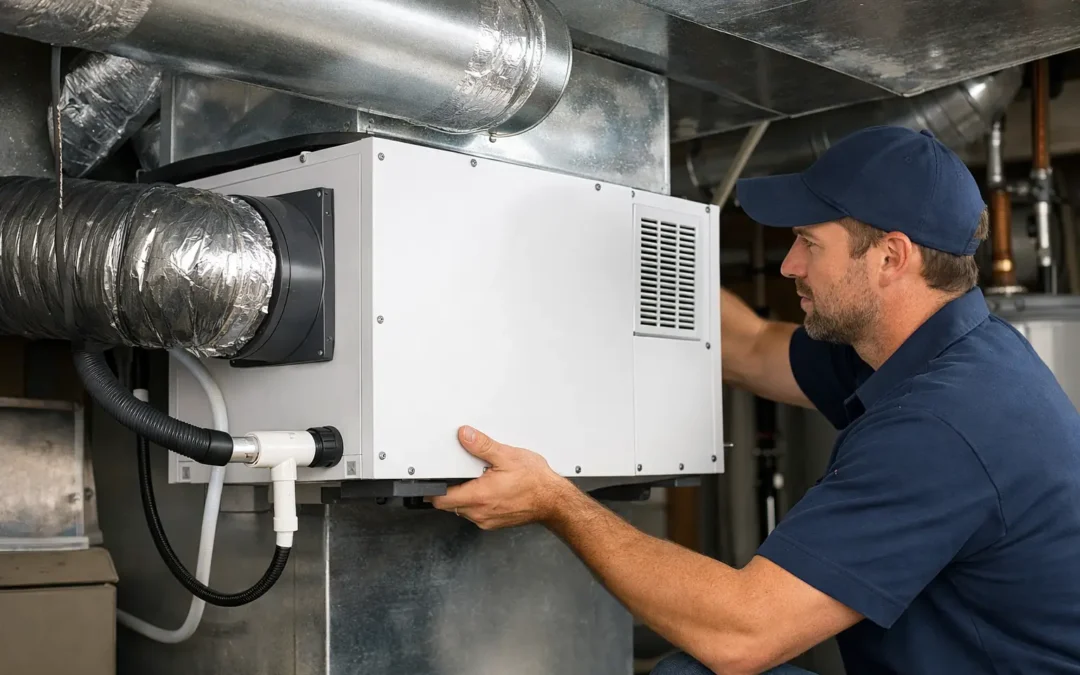
If your home feels sticky even when the AC is running, or you keep noticing musty smells, foggy windows, or damp spots in lower levels, the issue may be humidity, not temperature. Whole house dehumidifier installation is designed to solve that problem at the source by pulling excess moisture out of the air across your entire home, not just one room.
For many homeowners, this becomes a real quality-of-life upgrade. The air feels lighter, rooms become more comfortable, and problems like mildew growth, warped materials, and that persistent basement odor are easier to control. In Northern Virginia, where summer humidity can linger for months, a properly installed system can make a noticeable difference.
What a whole-house system actually does
A whole-house dehumidifier works with your HVAC system or as a dedicated ducted unit to remove moisture from indoor air before it circulates through the house. Unlike portable units, which only handle one area and need constant emptying, a whole-house system drains automatically and manages humidity much more consistently.
That consistency matters. High indoor humidity can make a home feel warmer than it is, which often leads people to lower the thermostat and put more strain on the AC. A dehumidifier helps you feel comfortable at a more reasonable temperature setting while also protecting the home itself.
This type of system is especially useful in homes with finished basements, crawl spaces, large return-air systems, or rooms that stay damp no matter how much the AC runs. It can also help property managers and business owners who need better moisture control in occupied spaces without relying on multiple standalone units.
When whole house dehumidifier installation makes sense
Not every home needs one, and that is where a professional evaluation matters. Some humidity problems are caused by duct leakage, poor ventilation, oversized AC equipment, or moisture intrusion from outside. If those issues are ignored, adding a dehumidifier may help, but it may not be the complete answer.
Still, there are some clear signs that whole house dehumidifier installation is worth considering. If your home regularly feels clammy, if the basement smells musty, if you see condensation on windows, or if mold keeps returning in bathrooms, closets, or lower levels, humidity is likely too high. Allergy symptoms can also get worse in damp conditions.
A good target for indoor relative humidity is usually around 45% to 50%, though the ideal setting can vary based on the season, the home, and any indoor air quality concerns. The goal is balance. Too much moisture creates comfort and air quality problems, but air that is too dry can create its own issues in winter.
How the installation process works
Most homeowners are less concerned with the mechanics than with what the job will involve, how long it will take, and whether it will disrupt the house. In most cases, installation is straightforward when handled by an experienced HVAC technician.
Evaluating the home and existing HVAC setup
The first step is assessing the home’s square footage, humidity levels, insulation, airflow, and duct configuration. The installer will also look at where moisture problems are worst and whether the existing HVAC system can support an integrated dehumidifier.
This step is important because sizing is not guesswork. A system that is too small may run constantly without bringing humidity down enough. A system that is too large can short cycle or add unnecessary cost.
Choosing the right installation type
Some whole-house dehumidifiers are installed directly into the central duct system, usually near the air handler. Others are set up as dedicated ducted systems that pull air from problem areas and supply dry air back into the home.
The best option depends on the house. If the ductwork is in good shape and the HVAC system is properly designed, an integrated setup may be the simplest route. In homes with separate humidity trouble zones, a dedicated ducted approach may offer better control.
Drainage, electrical, and controls
Because the system removes moisture continuously, it needs a reliable drain line or condensate pump. It also needs the proper electrical connection and a humidistat or smart control to manage setpoints.
This is one reason professional installation matters. If drainage is poorly designed or controls are not calibrated correctly, performance suffers and service issues can follow.
Whole house dehumidifier installation and ductwork
Ductwork is often the deciding factor in how smooth the project goes. If your ducts are well sealed and sized correctly, installation is usually more efficient. If there are leaks, poor airflow, or poorly balanced branches, those issues may need attention first.
That is not bad news. It is better to know up front than to install a new dehumidifier into a system that is already underperforming. In some homes, a few duct modifications are enough. In others, especially older homes or additions, the installer may recommend a dedicated return or supply connection to improve moisture removal.
This is also where experience matters. A rushed install might technically work, but a carefully planned one will do a much better job of delivering even comfort throughout the home.
What affects cost
Homeowners usually want a straight answer on pricing, and the honest answer is that it depends on the equipment and the home. Whole house dehumidifier installation cost is influenced by system capacity, ductwork needs, electrical work, drainage setup, access to the installation area, and control options.
A home that already has a modern, accessible HVAC system will usually cost less to equip than a home that needs duct updates or has limited space around the air handler. Commercial properties and larger homes may also require higher-capacity systems with more customized layouts.
What matters most is value over time. A properly installed system can reduce the burden on your AC, improve comfort, help protect flooring and drywall, and support healthier indoor air. Going with the cheapest option is not always the least expensive decision if it leads to poor humidity control or repeat service calls.
Benefits you notice right away
The first thing most people notice is that the home simply feels better. Air that was heavy and damp starts to feel cleaner and more stable. You may also find that rooms cool more evenly and the thermostat does not need to be set as low to stay comfortable.
There are practical benefits too. Lower humidity can help reduce mold and mildew risk, protect wood furniture and flooring, and make basements and storage areas more usable. It can also support better indoor air quality for households dealing with allergies or sensitivity to damp conditions.
For business owners and property managers, humidity control can also help protect finishes, inventory, and tenant comfort. That can be especially useful in buildings where moisture complaints keep coming back during the warmer months.
Why professional installation is the safer choice
Whole house dehumidifier installation is not a plug-and-play upgrade. The equipment has to be matched to the home, connected properly to air distribution, drained correctly, and set up to control humidity without interfering with HVAC performance.
A licensed, insured technician can evaluate the full picture instead of treating humidity as a standalone issue. That means checking airflow, static pressure, moisture sources, thermostat integration, and overall system compatibility. It also means you get clear recommendations instead of a one-size-fits-all answer.
For homeowners in places like Manassas, Fairfax, and surrounding Northern Virginia communities, that local knowledge can matter. Homes in this region often deal with humid summers, damp basements, and varying construction styles, so installation decisions should reflect real-world conditions, not just equipment specs on paper.
Aircon HVAC Solutions approaches these projects the way customers expect from a long-term comfort partner – with careful planning, transparent pricing, and workmanship that supports reliable performance after the install is complete.
A few questions worth asking before you schedule
Before moving forward, it helps to ask whether the humidity problem is whole-home or limited to one area, whether your current HVAC system is sized correctly, and whether any ventilation or drainage issues need to be addressed first. Those answers shape the best solution.
You should also ask how the system will be controlled, what maintenance it needs, and whether it will integrate with your existing setup. A good contractor should be able to explain all of that clearly, without overcomplicating the conversation.
The right dehumidifier should solve a real problem, not add another piece of equipment you have to think about every week. When it is installed correctly, it quietly does its job in the background and makes your home feel the way it should have all along.
If your home has been cool but never quite comfortable, excess humidity may be the missing piece, and addressing it can change more than the air – it can change how every room feels day to day.
