

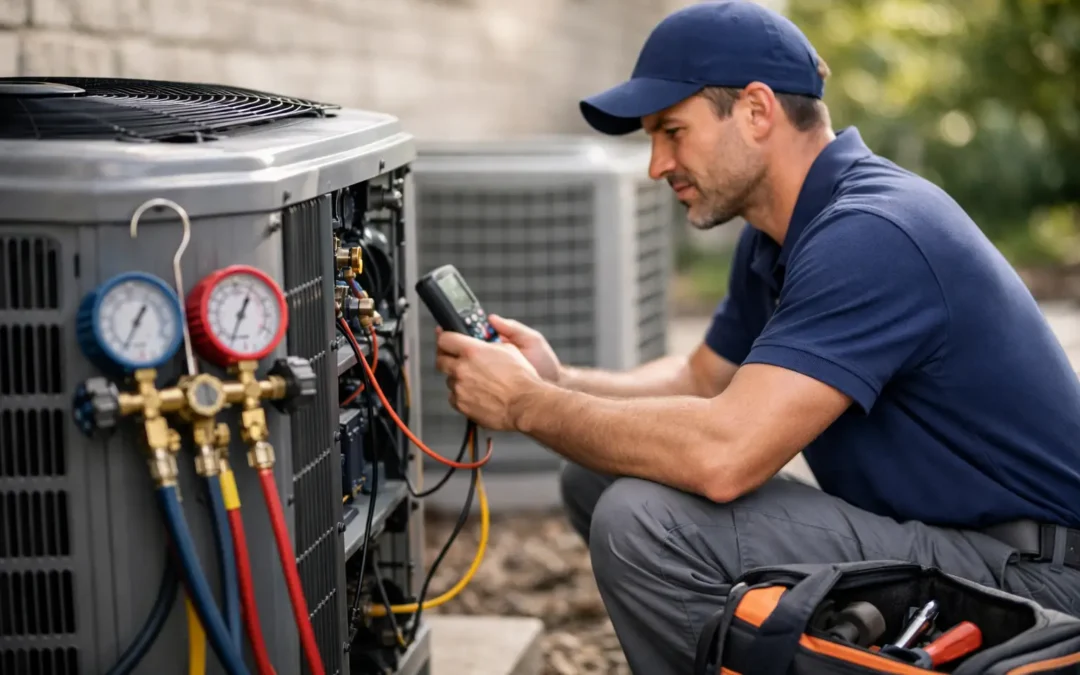
A failing air conditioner rarely picks a convenient time to act up. It may start blowing warm air during a humid Northern Virginia afternoon, trip the breaker before guests arrive, or leave one part of your building uncomfortable while the rest stays cool. The question is usually immediate: should you schedule ac repair before replacement, or is putting more money into the current system no longer the smart choice?
The right answer depends on more than the age of the equipment. A careful diagnosis can reveal a repair that restores dependable cooling for years. In other cases, recurring breakdowns, rising energy costs, and outdated equipment point toward replacement as the better long-term investment. The goal is not to push a new system when a repair will do. It is to give you a clear picture of your options, your costs, and what will best protect your comfort.
When AC Repair Before Replacement Is the Better Choice
Many common AC problems are repairable, even when they feel urgent. A worn capacitor, failed contactor, clogged condensate drain, damaged thermostat, electrical connection issue, or blower motor problem can stop your system from cooling properly without meaning the whole unit has reached the end of its life.
Repair is often the sensible path when your air conditioner is under 10 years old, has been maintained regularly, and has not needed frequent major work. If the issue is isolated and the repair cost is reasonable compared with the system’s remaining expected service life, fixing it can be the most cost-effective decision.
A good repair should do more than get cool air moving again for a few days. Your technician should identify the cause of the problem, inspect related components, and explain whether the repair is likely to provide reliable operation. That level of care helps prevent a small concern from becoming a larger, more expensive failure during peak cooling season.
Repairs that often make financial sense
If your system has generally cooled well and the problem is a single failed component, repair is usually worth considering. This is especially true after a maintenance visit identifies restricted airflow, a dirty coil, a drainage problem, or a thermostat issue early.
The same can apply to refrigerant-related concerns, but the diagnosis matters. Refrigerant does not simply get used up like fuel. Low refrigerant may signal a leak, and adding refrigerant without locating the source can lead to another breakdown. A qualified technician can determine whether repairing the leak and restoring the correct refrigerant charge is practical for your equipment.
For property managers and business owners, repair may also make sense when it can quickly restore service without disrupting tenants, employees, or customers. A transparent repair recommendation should account for the system’s condition and the operational needs of the property, not just the immediate malfunction.
Signs Replacement May Be the Smarter Investment
There is a point where repairs become a short-term patch on a long-term problem. Most central air conditioners last roughly 10 to 15 years, though installation quality, maintenance history, usage, and local weather all affect lifespan. Age alone does not require replacement, but an older unit with a major failure deserves a closer cost comparison.
Replacement is often worth serious consideration when your AC needs expensive repairs, breaks down repeatedly, or no longer cools your home or business evenly. If you are calling for service multiple times each summer, the cost and frustration can add up quickly. You may be paying to keep an inefficient system running while still dealing with hot rooms, excessive humidity, and high utility bills.
Another factor is refrigerant. Older systems may use R-22, an older refrigerant that is no longer produced or imported in the United States. Repairs involving R-22 can be costly and less practical because of limited supply. Depending on the condition of the system, replacement with a modern unit may offer better value and fewer future complications.
Watch for these replacement signals
Consider an AC replacement discussion if your system has a major compressor failure, a leaking evaporator coil, substantial corrosion, or electrical problems that continue after prior repairs. These are not automatic replacement decisions, but they can be costly enough to change the equation.
You should also pay attention to comfort changes. Loud operation, weak airflow, rooms that never reach the thermostat setting, unusual humidity, and steadily increasing electric bills can all indicate that the system is losing efficiency or capacity. A replacement may improve more than cooling. Properly sized new equipment can also support better airflow, humidity control, and overall indoor comfort.
How to Compare Repair Costs With Replacement Costs
A repair estimate should never be viewed in isolation. The better question is: what does this repair buy you? If a modest repair is likely to provide several more reliable years, it may be a good use of your money. If the same repair only delays another major issue on a worn system, replacement may be the more responsible choice.
One useful rule of thumb is to compare the repair cost with the age and condition of the equipment. An expensive repair on a 14-year-old system deserves more scrutiny than the same repair on a six-year-old system. Still, rules of thumb cannot replace an actual evaluation. A well-maintained older unit may have life left, while a newer system with repeated installation-related problems may not be worth repeated repairs.
Energy use also belongs in the conversation. Modern AC systems can be significantly more efficient than older models, but projected savings vary by equipment selection, home insulation, duct condition, thermostat settings, and daily use. Efficiency savings are a benefit, not a guarantee that replacement will pay for itself immediately. An honest recommendation should make that distinction clear.
Ask for a breakdown of the repair, the likely life expectancy after repair, the condition of key components, and the cost of replacement options. Clear pricing gives you room to make a decision based on your priorities, whether that means minimizing today’s expense or investing in dependable comfort for the next decade.
The Role of Maintenance in Your Decision
Routine maintenance can shift the repair-versus-replacement decision in your favor. Seasonal service helps catch worn parts, airflow restrictions, drainage issues, and electrical concerns before they cause a full shutdown. It also gives technicians a record of how your system is performing over time.
Maintenance cannot make aging equipment new again, but it can help it run more efficiently and predictably throughout its useful life. For newer systems, regular care may prevent the kind of avoidable repairs that make homeowners question a unit too soon. For older systems, it provides useful information for planning rather than forcing a rushed decision after a midsummer failure.
Simple habits help as well. Replace filters on schedule, keep outdoor equipment clear of leaves and debris, and avoid closing too many supply vents. If you notice unusual sounds, water around the indoor unit, weak airflow, or a sudden jump in utility costs, schedule service early rather than waiting for the system to stop completely.
What a Trusted AC Evaluation Should Include
Before recommending repair or replacement, a technician should assess the whole cooling system. That includes the outdoor unit, indoor coil, refrigerant levels, electrical components, thermostat operation, condensate drainage, airflow, and visible duct concerns. A quick guess based only on the age of the unit is not enough.
For replacement, the evaluation should also consider the size and layout of your home or commercial space. Installing a larger unit is not automatically better. Oversized equipment can cycle on and off too quickly, which may reduce humidity control and increase wear. Proper sizing and installation are essential to getting the comfort and efficiency you expect.
At Aircon HVAC Solutions, our focus is on helping Northern Virginia homeowners and businesses make practical, informed comfort decisions. Whether a targeted repair is the right answer or it is time to plan for a new system, you deserve prompt service, careful workmanship, and a recommendation that puts your needs first.
If your AC is struggling, do not assume replacement is inevitable or let repeated repairs become the default. Schedule a professional evaluation, ask direct questions, and choose the solution that gives you confidence when the next hot day arrives.
