

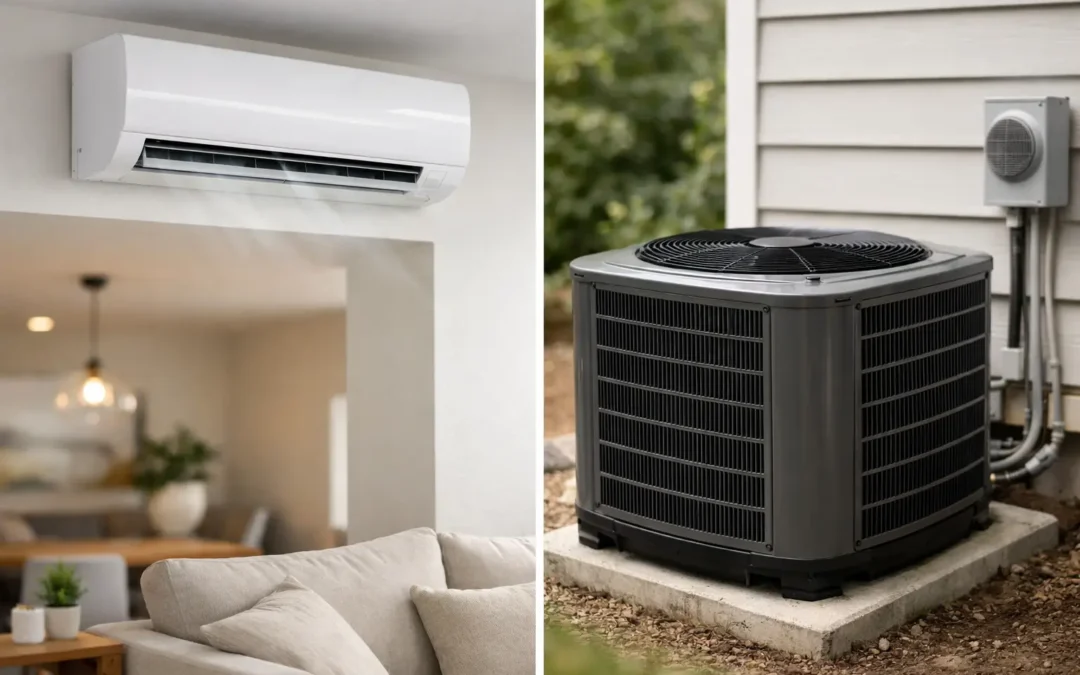
If you’re weighing mini split vs central air, you’re probably not shopping for equipment just for the sake of it. You’re trying to fix a real comfort problem – uneven temperatures, high utility bills, aging equipment, or a home addition that never seems to stay comfortable. The right answer depends less on what is “best” in general and more on how your home is built, how you use each room, and what kind of long-term cost makes sense for you.
Mini split vs central air: the core difference
A central air system cools your whole home through a network of ducts. One indoor unit, usually paired with an outdoor condenser, pushes conditioned air into multiple rooms through vents. It is the most familiar setup in many Northern Virginia homes, especially properties already built with ductwork.
A mini split system works differently. It uses an outdoor unit connected to one or more indoor air handlers mounted in specific rooms or zones. Instead of sending air through ducts, it delivers cooling directly where it is needed.
That basic difference shapes everything else – installation, efficiency, appearance, temperature control, and total project cost.
When central air makes more sense
Central air is often the better fit when you want whole-home cooling from a single system and your home already has ductwork in good condition. If every major room needs air conditioning and you prefer a more hidden look, central air is usually the more straightforward option.
It also tends to feel familiar to homeowners and property managers because the setup is simple to live with. You adjust one thermostat or a few connected zones, change filters on schedule, and keep up with seasonal maintenance. For larger homes with an existing forced-air system, central air can be the most practical way to cool the entire house evenly.
There is also the appearance factor. With central air, most of the visible equipment stays out of sight except for supply and return vents. If you do not want wall-mounted units in bedrooms, offices, or living areas, that matters.
That said, central air depends heavily on the condition of the duct system. If ducts are leaking, poorly sized, or routed through very hot attic spaces, some of the system’s efficiency can be lost before cool air ever reaches the rooms you use.
When a mini split is the better choice
Mini splits are especially useful when ductwork is missing, limited, or not worth extending. That makes them a strong option for older homes, finished basements, garages, sunrooms, home additions, and spaces that stay warmer or cooler than the rest of the house.
They also work well when different people want different temperatures in different rooms. A mini split can cool a bedroom at night without overcooling the rest of the home. For households that use some spaces heavily and others only occasionally, that kind of room-by-room control can translate into lower energy use.
Installation is often less disruptive than adding or replacing full duct systems. Instead of opening walls and ceilings to run ductwork, mini splits usually require a small line set connection between the indoor and outdoor components. For many homes, that can shorten the project timeline.
The trade-off is visibility. Indoor heads are part of the room, and while many homeowners get used to them quickly, others never love the look. That’s a personal decision, but it should be part of the conversation early.
Cost: upfront price vs long-term value
This is where many decisions get more complicated.
Central air may be more cost-effective if your home already has sound ductwork and you are replacing an older system with something similar. In that case, the installation is often more predictable, and the total project cost can stay more manageable than people expect.
Mini splits can be affordable for a single room or a targeted problem area. But if you are trying to cool an entire large home with multiple indoor units, the total cost can rise quickly. More zones mean more equipment, more labor, and more complexity.
Long-term operating cost depends on how you use the system. Mini splits are often very efficient, especially when you are only conditioning occupied spaces. Central air can also perform well, particularly with newer high-efficiency equipment and properly sealed ducts. But if the whole house is being cooled all day whether rooms are occupied or not, energy use can be higher.
The most useful way to think about price is not “Which system is cheaper?” but “Which system solves my comfort problem with the least waste over time?”
Comfort and temperature control
Comfort is not just about reaching a thermostat setting. It is about whether the rooms you use actually feel right throughout the day.
Central air offers consistent, whole-home cooling when the system is designed well and the ductwork supports it. Many homeowners like the even feel of air moving through the house and the convenience of one integrated system.
Mini splits offer precision. Each zone can usually be adjusted independently, which is helpful if one side of the home gets more sun, an upstairs bedroom runs hot, or a home office needs daytime cooling while the rest of the house does not.
Neither system guarantees perfect comfort on its own. Poor sizing, bad installation, and skipped maintenance can create problems with either option. That is why system design matters as much as brand or efficiency rating.
Efficiency and indoor air considerations
Mini splits have a strong reputation for efficiency because they avoid duct losses and can cool only the spaces being used. For certain layouts, that is a real advantage.
Central air can still be a strong performer, especially in homes where ducts are sealed, insulated, and properly balanced. It may also be easier to integrate with whole-home filtration, humidity control, and other indoor air quality upgrades. For homeowners in Northern Virginia, where summer humidity can be just as uncomfortable as heat, that bigger indoor comfort picture matters.
If allergies, dust, or moisture control are major concerns, the right choice may come down to more than cooling alone. A professionally evaluated system should account for airflow, filtration, and humidity rather than focusing only on temperature.
Installation realities homeowners often miss
A lot of frustration starts when people assume any HVAC system can be swapped in without looking at the structure of the home.
Central air installation may be simple in a home with existing ducts, but much more involved in a house that was never designed for them. Adding ductwork can affect ceilings, closets, attic access, and overall labor cost.
Mini split installation avoids those duct challenges, but placement still matters. Indoor unit location, line routing, condensate drainage, and outdoor unit positioning all affect performance and appearance. In commercial spaces and multi-room residential projects, planning the zones correctly is just as important as the equipment itself.
This is why an on-site assessment matters. The best recommendation should reflect the home’s layout, insulation, existing HVAC setup, and the way the property is actually used.
Which system is better for your situation?
If you already have ductwork, want a cleaner look, and need reliable whole-home cooling, central air is often the better fit. If you have a specific hot room, a new addition, an older home without ducts, or you want more control over individual spaces, a mini split may be the smarter investment.
For some properties, the best answer is a mix. A central system may handle the main home while a mini split supports a finished attic, garage conversion, or sunroom that the main system struggles to reach. That kind of hybrid approach can solve comfort issues without forcing a full redesign.
The right system is the one that matches the building, the budget, and the way you live or work in the space every day.
A practical way to decide
If you’re still stuck on mini split vs central air, start with the parts of the home that are not working well right now. Is the issue whole-house cooling, one problem room, rising energy bills, or an aging system that needs replacement anyway? Once that is clear, the equipment choice usually gets easier.
A trustworthy HVAC contractor should be able to explain not just what they recommend, but why. That means looking at square footage, duct condition, insulation, occupancy patterns, and your long-term plans for the property. At Aircon HVAC Solutions, that is the kind of conversation that helps customers make confident decisions instead of rushed ones.
Good HVAC decisions are rarely about picking a winner on paper. They are about choosing the system that will keep your space comfortable, efficient, and dependable when the weather puts it to the test.
