

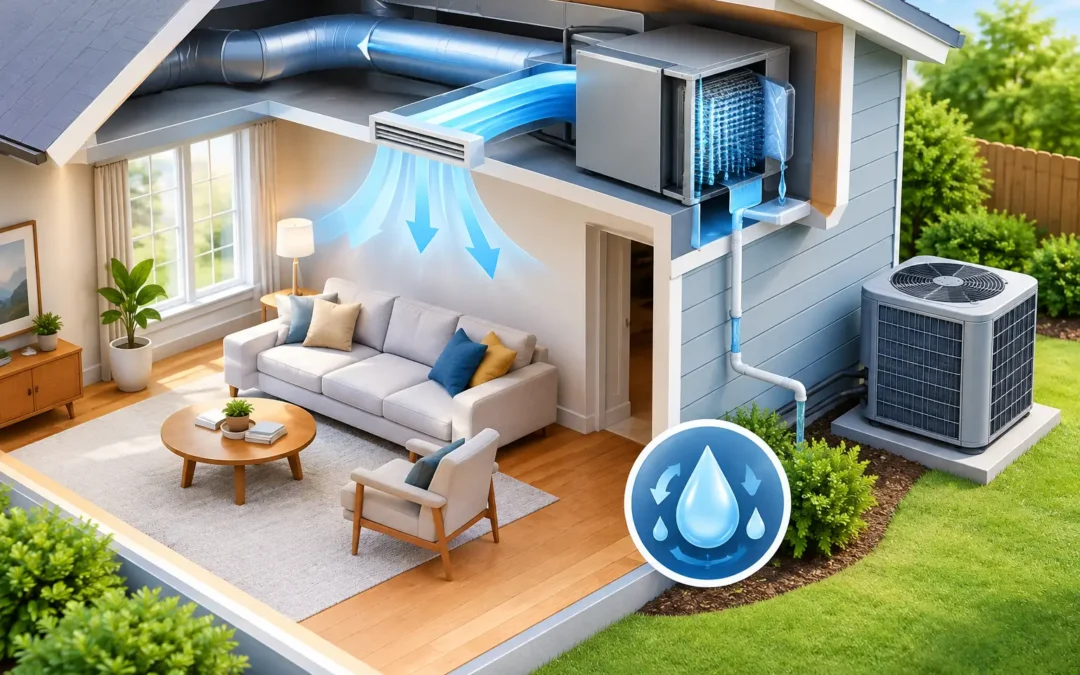
A home can feel sticky even when the thermostat says it is cool. Windows may fog, rooms may smell musty, and your AC may run for long stretches without making the space feel truly comfortable. Knowing how to reduce HVAC humidity helps you protect indoor comfort, limit moisture-related damage, and make better decisions about service or equipment upgrades.
In Northern Virginia, humid summers put serious demand on air conditioning systems. Your AC should remove heat and a meaningful amount of moisture at the same time. When humidity stays high indoors, the cause may be as simple as an incorrect thermostat setting or as complex as an oversized system, poor drainage, or inadequate ventilation.
What indoor humidity should be
Most homes feel best when relative humidity stays between 30% and 50%. During the cooling season, many households aim for roughly 40% to 50%. At that level, the air feels more comfortable, floors and fabrics dry more quickly, and your AC does not have to work as hard to offset the sticky feeling created by excess moisture.
A basic hygrometer can show your indoor humidity level. If readings regularly remain above 55% while the air conditioner is operating, it is worth investigating. Readings above 60% deserve prompt attention, especially if you notice condensation, mildew odors, peeling paint, or visible mold growth.
Start with the HVAC settings you control
Before assuming you need new equipment, check the settings that affect how long and how effectively your system runs.
Set the thermostat fan to Auto, not On. In the Auto setting, the blower stops when the cooling cycle ends. This allows moisture collected on the indoor evaporator coil to drain away. When the fan is set to On, it can keep moving air across that wet coil and return some moisture to the house.
Avoid setting the temperature dramatically lower in an effort to dry the air faster. Lowering the thermostat may make the system run longer, but it can also waste energy and create an overly cold home. A steady setting around 72 to 76 degrees is often more practical, depending on your comfort preference, insulation, sunlight exposure, and occupancy.
If your thermostat has a humidity setting or a dehumidification mode, use it carefully. Some systems can prioritize moisture removal by adjusting fan speed or cooling cycles. Not every HVAC system supports this feature, so it is best to confirm that the setting is compatible with your equipment before relying on it.
Keep the air conditioner maintained
An AC that is dirty, restricted, or poorly drained cannot manage humidity as intended. Routine maintenance is not only about preventing breakdowns. It also supports the moisture-removal performance your home depends on during a Virginia summer.
Start with the air filter. A clogged filter limits airflow across the evaporator coil. Restricted airflow can reduce cooling performance, contribute to coil freezing, and interfere with effective dehumidification. Check the filter monthly during heavy-use periods and replace it according to the manufacturer’s recommendation or sooner when it appears dirty.
The indoor coil, outdoor coil, blower components, and condensate drain line also need professional attention. The evaporator coil pulls moisture from indoor air, which then drains through a condensate line. If that line is partially blocked, water may back up, cause leaks, trigger a safety switch, or create conditions for biological growth near the equipment.
During a professional AC tune-up, a technician can check refrigerant performance, airflow, drainage, electrical components, and overall system operation. Those details matter because high humidity is often a symptom of several small performance issues rather than one obvious failure.
Make sure the system is properly sized
An oversized air conditioner is one of the most common reasons a home feels cool but humid. Larger is not always better in HVAC. A system that is too large can cool the house very quickly and shut off before it has run long enough to remove sufficient moisture.
This pattern is called short cycling. You may notice frequent starts and stops, uneven temperatures, high humidity, and higher wear on system components. A properly sized system should be selected using a detailed load calculation that considers square footage, insulation, windows, ceiling height, sun exposure, ductwork, and the number of people using the space.
An undersized system can create humidity concerns too, particularly during extreme weather. It may run continuously and still fail to keep up with the heat and moisture entering the home. The right fix depends on the equipment, the building, and the source of the moisture. Replacing equipment without assessing those factors can lead to the same problem all over again.
Improve airflow without creating moisture problems
Balanced airflow helps your HVAC system condition the whole home more evenly. Keep supply vents open and unobstructed by furniture, rugs, or drapes. Closing too many vents can increase static pressure in the ductwork and reduce the airflow your system needs.
Duct leaks are another concern. In a hot attic, crawl space, or unconditioned area, leaking return ducts can pull humid outdoor air into the system. Leaking supply ducts can send cooled, dehumidified air where it does not belong. Both situations make your AC work harder while rooms remain uncomfortable.
A professional duct inspection can identify leakage, poor connections, insulation gaps, and airflow imbalances. For larger homes and commercial spaces, zoning or targeted duct modifications may help address persistent humidity in specific rooms. The right approach should improve comfort without sacrificing proper system operation.
Reduce moisture at its source
Your air conditioner should not have to handle every source of indoor moisture by itself. Everyday activities such as showering, cooking, laundry, and even large gatherings add water vapor to the air.
Use bathroom exhaust fans during showers and leave them on for about 15 to 20 minutes afterward. Run the kitchen exhaust fan while cooking, particularly when boiling water. Make sure a clothes dryer vents outdoors rather than into a garage, attic, crawl space, or interior area.
Basements and crawl spaces deserve special attention. Moisture can enter through foundation walls, slab floors, plumbing leaks, poor exterior drainage, or unsealed crawl spaces. If the lower level is damp, musty, or showing signs of mold, the solution may involve drainage improvements, vapor barriers, sealing, or a dedicated dehumidifier rather than more air conditioning.
When a whole-home dehumidifier makes sense
A portable dehumidifier can help in a single room, basement, or temporary problem area. It can be useful when you need immediate relief, but it requires regular emptying or a drain connection, produces some heat, and may not control humidity throughout the home.
A whole-home dehumidifier is often a better long-term option for homes with persistent humidity issues. It connects to your HVAC system or operates as part of a planned indoor air quality solution. These systems remove moisture from the air throughout the house and can help maintain a more consistent humidity level without forcing the thermostat lower.
This can be especially valuable for homes with finished basements, high occupancy, older construction, large window areas, or recurring moisture issues during the summer. Property managers and commercial building operators may also benefit from dedicated dehumidification in spaces where occupant comfort, inventory, equipment, or indoor air quality is affected by moisture.
Signs it is time to schedule HVAC service
Call for professional help if you see water around the indoor unit, smell persistent mildew, hear the system cycling repeatedly, or find indoor humidity staying above 55% despite normal AC operation. Ice on refrigerant lines, weak airflow, uneven cooling, and a condensate drain that repeatedly clogs also warrant an inspection.
A trained technician can determine whether the issue involves airflow, refrigerant, drainage, ductwork, system sizing, ventilation, or an indoor moisture source outside the HVAC equipment. That clear diagnosis matters. Treating humidity by simply lowering the thermostat can hide the real problem and increase your energy costs.
For homeowners and businesses in Bristow, Manassas, Gainesville, Centreville, Chantilly, Fairfax, Herndon, McLean, and Reston, Aircon HVAC Solutions can evaluate the full comfort picture and recommend practical next steps with clear pricing. A dry, comfortable home should not require guessing – it starts with a system that is maintained, properly matched to the space, and ready for the season ahead.
