

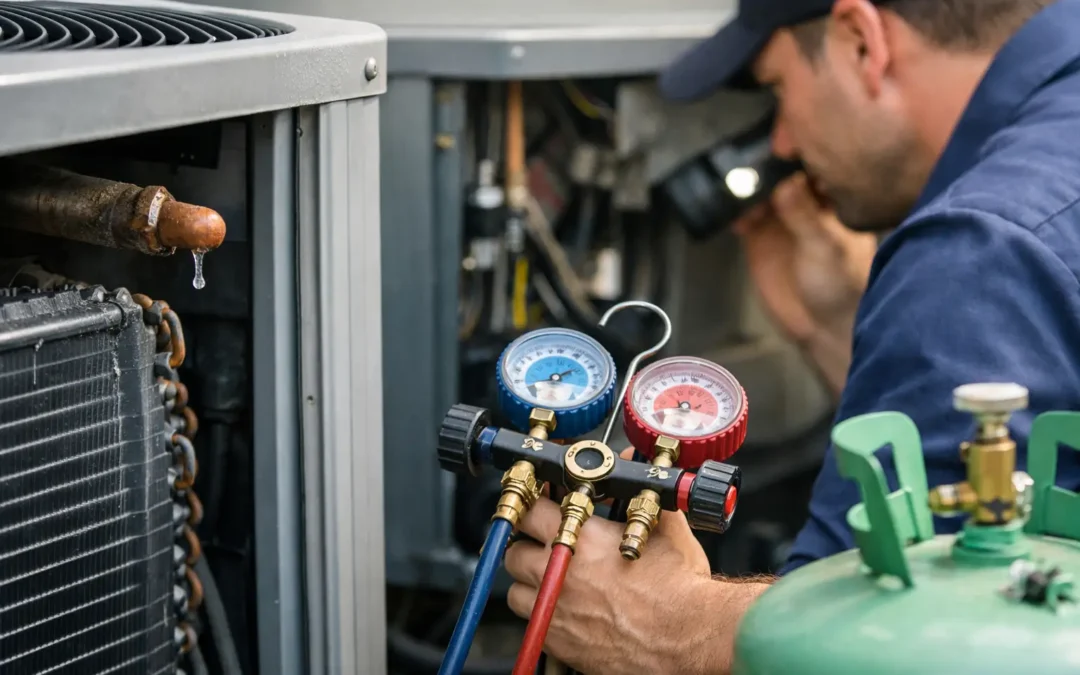
Your AC can still turn on, blow air, and sound mostly normal while quietly losing its ability to cool. That is what makes ac refrigerant leak symptoms easy to miss at first. By the time many homeowners or property managers realize something is wrong, the system has been running harder, cooling less, and putting extra strain on key components.
A refrigerant leak is not the kind of problem to wait out. Refrigerant is part of a sealed system, so if levels are low, there is usually a leak somewhere that needs professional attention. Catching the signs early can help you avoid higher energy costs, uneven comfort, and more serious damage.
What refrigerant does in your AC system
Refrigerant is the substance that absorbs heat from inside your home and releases it outdoors. When the charge is correct, your AC can move heat efficiently and keep indoor temperatures stable.
When refrigerant leaks out, the system loses cooling capacity. That does not always mean the AC stops immediately. In many cases, it keeps running but struggles to meet the thermostat setting. That is why this issue often shows up as a comfort problem before it looks like a breakdown.
Common AC refrigerant leak symptoms
Some symptoms are obvious, while others can look like a dirty filter, airflow issue, or aging equipment. The difference is that refrigerant problems tend to worsen over time if the leak is not found and repaired.
Your home takes longer to cool
One of the first signs is slower cooling. If your system used to bring the house down to the set temperature without much trouble and now seems to run for long stretches, low refrigerant could be part of the problem.
This matters most when outdoor temperatures rise and the system is already working hard. A small leak may not be noticeable during mild weather, but it often becomes clear during the hottest afternoons.
The air from the vents feels less cool
If the AC is on but the air coming from the supply vents feels weakly cool or close to room temperature, that is a sign the system may not be removing heat properly. Homeowners often describe this as the AC blowing air but not really cooling.
That symptom can also point to other issues, including a failing compressor or restricted airflow. Still, when it happens alongside long run times and higher bills, a refrigerant leak moves higher on the list.
Ice forms on the refrigerant line or evaporator coil
Many people are surprised to learn that a leak can cause freezing. Low refrigerant changes the pressure in the system, which can make the evaporator coil get too cold. Moisture in the air then freezes on the coil or refrigerant line.
If you notice ice on the indoor unit, the copper line, or around the outdoor equipment, turn the system off and schedule service. Continuing to run it can make the problem worse. Ice does not always mean a leak, but it is never something to ignore.
Your energy bills start climbing
An AC low on refrigerant usually has to run longer to do the same job. Longer cycles mean more energy use, especially during peak cooling season.
If your utility bill jumps and your habits have not changed much, the cause may be hidden in the system rather than obvious at the thermostat. Rising operating costs are one of the most overlooked ac refrigerant leak symptoms because they do not feel urgent at first.
You hear hissing or bubbling sounds
Refrigerant leaks can sometimes be heard. A small leak may create a hissing sound as refrigerant escapes through a tiny hole or crack. A larger issue may produce a bubbling noise.
Not every noisy AC has a refrigerant problem, and not every refrigerant leak is loud enough to hear. But if the sound is new and comes with poor cooling performance, it is worth having checked quickly.
Indoor humidity feels higher than usual
Your AC does more than cool the air. It also helps remove excess humidity. When refrigerant is low, the system may struggle to control moisture as effectively, leaving the home feeling clammy even when the thermostat reading seems close to normal.
This can be especially noticeable in Northern Virginia summers, when humidity already pushes indoor comfort in the wrong direction. If the house feels sticky and the AC seems to run constantly, low refrigerant could be contributing.
The thermostat never seems satisfied
Another common pattern is an AC that keeps running without ever quite reaching the set temperature. You lower the thermostat, the unit turns on, and it just keeps going.
That can happen for several reasons, including undersized equipment or poor insulation. But if the problem appears suddenly in a system that previously cooled well, a leak becomes more likely.
The system short cycles or shuts down unexpectedly
In some cases, low refrigerant can create pressure or temperature conditions that cause the system to cycle irregularly. Instead of running steady, it may turn on and off too often or trip safety controls.
This is one of those symptoms that depends on the type of equipment and the size of the leak. Some units limp along with weak cooling. Others become erratic much sooner.
Why you should not just add more refrigerant
A common misconception is that refrigerant gets used up like fuel. It does not. In a properly sealed AC system, refrigerant should not need to be topped off routinely.
If the charge is low, there is almost always a leak. Adding refrigerant without finding and repairing the source may provide temporary relief, but it does not solve the underlying problem. The leak remains, performance drops again, and the system continues to operate under stress.
There is also a cost issue. Recharging a leaking system over and over can become more expensive than diagnosing it properly the first time.
What causes refrigerant leaks
Leaks can happen for a few different reasons. Corrosion on the coils is a common one, especially over time. Vibration can weaken connections. Factory defects, physical damage, and wear on joints or fittings can also play a role.
The age and condition of the equipment matter here. In some systems, repairing a single leak makes sense. In others, especially older units with multiple problem points, replacement may be the more practical long-term choice. That is why a good diagnosis matters more than guessing.
What to do if you notice AC refrigerant leak symptoms
Start by turning the system off if you see ice buildup or if cooling has dropped off sharply. That can help prevent additional strain on the compressor, which is one of the most expensive parts to replace.
Then schedule a professional inspection. A licensed technician can check pressures, inspect the coil and line set, locate the leak, and recommend whether repair or replacement makes more sense. The right answer depends on the leak location, refrigerant type, repair cost, and the age of the unit.
For homeowners and commercial property managers, speed matters. The longer the system runs with low refrigerant, the greater the chance of added wear and a more expensive repair.
When repair makes sense and when replacement may be smarter
Not every leak means you need a new AC. If the system is relatively new, in otherwise good condition, and the leak is accessible, repair can be the right move.
But there are trade-offs. If the equipment is older, has a history of breakdowns, or uses outdated refrigerant, investing in repeated repairs may not be the best use of your budget. In those cases, replacement may offer better reliability, lower operating costs, and fewer disruptions during the hottest part of the season.
A trustworthy HVAC company should walk you through both options clearly, with pricing and realistic expectations rather than pressure.
A small comfort issue can turn into a major repair
The challenge with refrigerant leaks is that they often start quietly. A room that feels a little warmer, an AC that runs a little longer, a bill that looks a little higher – none of that seems dramatic on day one. But those early signs are often your best chance to fix the problem before it affects the compressor or leaves you without cooling when you need it most.
If something about your AC feels off, trust that instinct. Getting it checked early is usually the most practical way to protect your comfort, your equipment, and your budget.
