

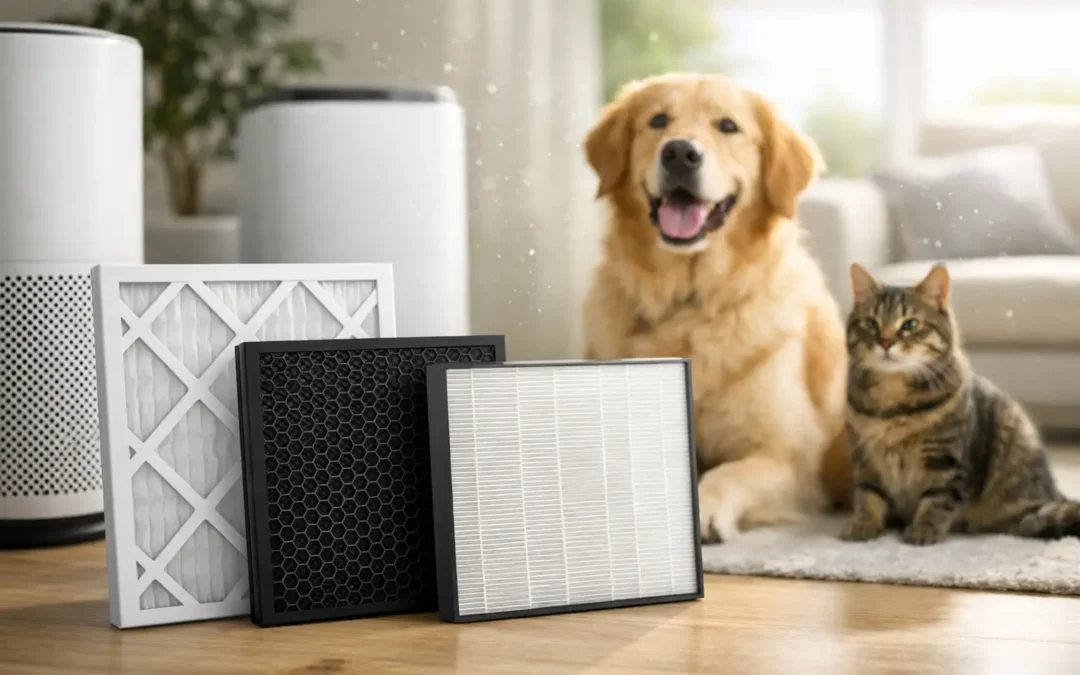
Pet hair along baseboards is easy to spot. The finer particles your pet leaves behind are not. Dander, dried saliva, dust carried in on paws, and litter-related particles can keep circulating through your home long after the couch has been vacuumed. Choosing the best air filters for pets can reduce that buildup, protect HVAC equipment, and help your home feel more comfortable for family members with allergies.
The right choice is not automatically the highest-rated filter on the shelf. Your HVAC system needs a filter that captures meaningful particles without restricting airflow beyond what the equipment can handle. For most Northern Virginia homes with dogs or cats, a quality pleated filter in the right MERV range is the practical starting point.
What Pet-Related Air Filters Need to Catch
Pet hair is only part of the issue. It is large and usually gets trapped in return grilles, vacuumed from floors, or collected by a basic filter before it reaches sensitive HVAC components. The particles that can be harder to manage are pet dander and the dust it attaches to. Dander is made up of tiny flakes of skin, and it can remain airborne when a pet moves, shakes, or settles into bedding.
A good filter should also help control everyday household dust, pollen, and fibers. In this region, spring and fall pollen can add another layer to the indoor air quality challenge, especially when pets bring allergens inside on their coats.
Odors are different. Standard pleated filters are designed to capture particles, not remove smells. If pet odor is a major concern, look for a filter with a modest activated-carbon layer or consider a whole-home air purification solution. Carbon can help with odors and some gases, but it needs to be paired with proper cleaning, ventilation, and regular litter-box or pet-area care.
The Best Air Filters for Pets Usually Have a MERV 8 to 13 Rating
MERV stands for Minimum Efficiency Reporting Value. It describes how effectively a filter captures particles within certain size ranges. A higher MERV number generally means finer filtration, but it can also mean more resistance to airflow. That trade-off matters because restricted airflow can reduce comfort, strain a blower, and contribute to avoidable system problems.
MERV 8: A Reliable Basic Choice
A pleated MERV 8 filter is a solid option for homes with one pet, no major allergy concerns, and a system that has not been evaluated for higher-efficiency filtration. It captures common dust, pollen, lint, and many larger airborne particles while allowing relatively easy airflow.
MERV 8 may be enough if your home is kept clean, your pet sheds lightly, and you replace the filter consistently. It is a meaningful step up from thin fiberglass filters, which provide limited particle capture and are mainly intended to protect equipment.
MERV 11: The Sweet Spot for Many Pet Owners
For many households with dogs or cats, MERV 11 offers the best balance between filtration and HVAC performance. It captures smaller particles than MERV 8, including more fine dust and dander-bearing particles, without being as restrictive as higher-rated options.
This rating is often a practical choice for families dealing with visible dust, moderate shedding, seasonal allergies, or multiple pets. Still, filter performance depends on correct sizing, the condition of ductwork, and the blower capacity of your particular system.
MERV 13: Stronger Filtration, With a System Check
MERV 13 filters provide finer particle capture and can be valuable for homes where allergies or asthma are a serious concern. They can catch smaller airborne particles that lower-MERV filters may miss. However, they are not right for every furnace, heat pump, or air handler.
Before moving to MERV 13, confirm that your system can support it. A technician can check static pressure, return-air capacity, filter cabinet size, and blower performance. Installing a highly restrictive filter in an older or undersized system is not a shortcut to cleaner air. It can create airflow problems that affect heating, cooling, and equipment life.
Choose a Pleated Filter, Not the Cheapest Filter
For pet owners, pleated filters are usually the better value. Their folded media creates more surface area than flat fiberglass filters, allowing them to collect more particles while maintaining reasonable airflow. A well-made pleated filter also tends to hold its shape better as it loads with dust and hair.
Avoid choosing solely by price or by a package claim that promises the highest possible filtration. The best filter is one that fits tightly, meets your system’s specifications, and is replaced before it becomes overloaded. An incorrectly sized filter allows air to bypass the media, carrying dust and dander straight into the system.
Check the dimensions printed on the existing filter frame, but do not assume the labeled size is the exact size. A filter marked 16 x 25 x 1 is often slightly smaller in its actual dimensions. Match the size required by the filter rack, and make sure the airflow arrow points toward the equipment.
One-Inch Filters Need More Frequent Attention
A one-inch filter is common in many homes, but it has limited surface area. In a household with pets, it may need replacement every 30 to 60 days, particularly during heating and cooling seasons when the system runs often. If you have several shedding pets, renovations underway, or family members with allergies, monthly checks are a safer routine.
Thicker media filters, commonly four or five inches deep, have more surface area and can often last longer while providing excellent filtration. Depending on the filter, occupancy, and pet activity, they may be replaced every six to 12 months. They require a compatible filter cabinet, so they are not a simple swap for every system.
Do not rely only on the calendar. Check for visible dust accumulation, a gray or matted surface, reduced airflow from vents, or unusually frequent cycling. A filter that is clogged with pet hair and dust can make rooms less comfortable and force your equipment to work harder.
HEPA Filters Are Not Usually a Direct HVAC Replacement
HEPA filters are known for very high particle-capture performance, so it is understandable that pet owners ask for them. In most standard residential HVAC systems, however, a true HEPA filter is too restrictive to install in the regular filter slot. Using one without a designed-in system can severely limit airflow.
If you need HEPA-level filtration for a sensitive household member, a properly sized portable room air cleaner can be a useful companion to your HVAC filter. Put it in the bedroom, main living area, or the room where pets spend the most time. A whole-home solution may also be possible, but it should be selected and installed based on your system rather than a one-size-fits-all claim.
Improve Results Beyond the Filter
Even the best filter cannot capture particles that never reach the return vents. Regular cleaning keeps dander and hair from being stirred back into the air. Vacuum upholstery and pet bedding with a sealed vacuum, groom pets as appropriate for their coat type, and wipe return grilles so hair does not build up at the intake.
Keep supply and return vents open and unobstructed. Closing vents or blocking returns with furniture can disrupt airflow and reduce the amount of air that reaches the filter. If you notice recurring dust, persistent pet odors, uneven temperatures, or allergy symptoms despite regular filter changes, the issue may involve duct leakage, humidity, ventilation, or equipment airflow rather than the filter alone.
For property managers and commercial spaces, filter schedules should reflect occupancy and use. A pet-friendly rental, veterinary-related office, or business with heavy foot traffic may need more frequent inspections than a low-occupancy office. Consistent maintenance protects equipment and gives occupants a better indoor environment.
When to Ask an HVAC Professional
A filter upgrade is worth a professional review when your system struggles after switching filters, rooms have weak airflow, or you want to move from a one-inch filter to a deeper media cabinet. It is also smart to schedule an assessment if your home has persistent odors, excessive dust, or family members with significant respiratory sensitivities.
Aircon HVAC Solutions can evaluate airflow, filtration options, humidity, and whole-home indoor air quality upgrades so the solution supports both cleaner air and dependable system performance. A properly matched filter is a small part with a major role in the comfort of your home.
The most effective routine is simple: use a quality pleated filter your HVAC system can handle, inspect it regularly, and respond early when your home tells you the air is not as fresh or comfortable as it should be.
